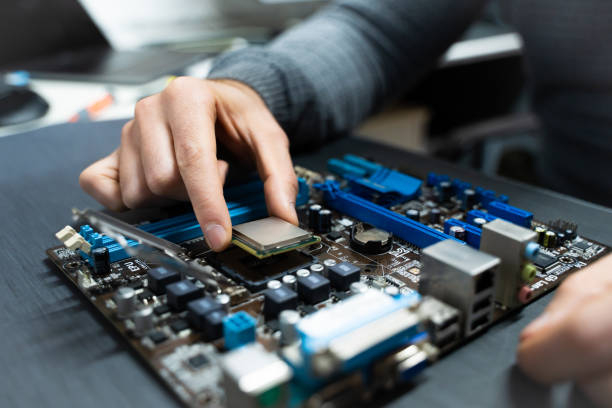
A laptop motherboard Repairable is indeed one of the most crucial and most complicated parts of a computer, and once it gets a fault, many users think that the only way out is to buy a new one. However, a laptop motherboard is often healing depending on the type of damage, the extent of the problem and the presence of skilled technicians and proper tools. Motherboard repair has started to be a norm in recent years where high-tech diagnostics and micro-soldering equipment have allowed the technicians to work on problems that were regarded as unfixable in the past.
The repairability of a laptop motherboard basically relies on the issue being treated. For example, minor defects like broken charging ports, defective power ICs, capacitors that have burst or short-circuits due to power surges are likely to be repaired with great success. Usually, these defects do not affect the whole motherboard but only a part, so repairs can be done that way. Thus, replacing or re-soldering the damaged parts can bring the motherboard back to a full working state at a fraction of the cost of a new one.
Water damage is another reason for a motherboard’s demise and its ability to be repaired depends on how fast the laptop is turned off and how soon it is serviced. If rust has not gone far and the parts that are affected can be either cleaned or replaced then the motherboard is often refurbished. On the other hand, if the board was moist for a long time, it could get damaged so deep that the repair is not worth it or is difficult. Still, liquid-damaged motherboards sometimes can be saved, especially if they are in the hands of skilled repair specialists.
Repairing physical damage to the motherboard, e.g. cracks or broken sections, is usually more time-consuming and costly. Internal connections that are difficult to restore quite often suffer from structural damage because of the multi-layered and component-dense modern laptop motherboard design. In such cases, repair might not be dependable, and the option of replacement is likely to be offered. In the same way, major breakdowns of chipset or CPU can cause worn out the likelihood of repair if the parts are soldered to the motherboard for good.
The price aspect is an important factor in the decision-making process regarding the fixing or replacing of a laptop motherboard. In case of older laptops or budget models, the cost of repair might come to about the same or even more than the worth of the device, thus making replacement a more logical choice. However, in case of high-end laptops or motherboards that are expensive or tough to find, repair can be an effective and smart option in terms of costs. Besides, the existing motherboard can be repaired which would in turn help to keep the data and system configurations that might otherwise be lost during a replacement process.
Another critical aspect to consider is the technician’s skills. Fixing a motherboard is not an easy task as it requires technical expertise and specialists for diagnosing and also entails using modern equipment such as hot air stations, microscopes, and circuit diagrams. Not all service centers are equipped to do coming motherboard-level repair, and some might even go so far as to recommend a replacement outright just because they are incapable of doing a repair. The presence of a qualified and skilled technician will very much increase the probability of a successful and long-lasting repair.
To sum up, a laptop motherboard is usually repairable, but its repairability is conditioned on the fault type, the damage level, the involved cost, and the technician’s skill. Not every motherboard is a candidate for repair, and furthermore, hundreds of non-critical issues can be effectively repaired, thus making it a practical and economical solution in many cases.
Also visit our Laptop Mother Board Price
What types of laptop motherboard problems can be repaired instead of replaced?
Types of laptop motherboard problems can be repaired instead of replaced becomes possible in most cases, especially when the problem concerns individual components and not the entire board. It is good to know what kind of faults are amenable to repair as this enables the users to save money and prolong the life of their laptops. The use of modern diagnostic tools and competent technicians means that it is possible to fix several common motherboard issues through specific repairs rather than through expensive replacements.
One of the biggest power-related issues is that they are the most common of the motherboard problems that are repairable. A laptop not powering up, sudden shutdowns, or battery not charging are a few of the symptoms that can be traced back to power integrated circuits, voltage regulators, metal-oxide-semiconductor field-effect transistors (MOSFETs), or capacitors being burnt out. The aforementioned components are, in most cases, subject to testing and one-by-one replacement which will lead to the proper power flow being restored without the whole motherboard being replaced.
Repairs of damaged charging ports and DC jacks is another case where almost always the fix is possible. Loosening or breaking the charging port caused by continuous plugging and unplugging will lead to intermittent charging or complete power failure. Since a charging port is a separate component soldered onto the motherboard, removing the damaged port and installing a new one is relatively easy for the technicians.
Short circuits and blown components caused by power surges or faulty adapters are also repairable in many cases. A short circuit may damage resistors, coils, or capacitors in a specific area of the motherboard. By pinpointing the damaged area and changing the defective parts, the motherboard can be restored to its functional state.
Liquid spills are usually the cases of motherboard repair if the problem is detected early. A liquid spill harms the laptop very badly, because, besides through the motherboard, water might get to the battery or other places and cause corrosion and rust that would destroy chips or contracts that might become faulty. The dead parts can be reclaimed after use of special cleaning solutions and processes to clean the whole motherboard, but only if the damage has not widely extended over several layers of the board and they are also not dead.
Another type of problem that can be fixed through repair is overheating. Heat can deteriorate the power chips, graphics chips, and solder joints leading to a series of problems like display issues, random freezes, and boot failures that can be solved without the motherboard being replaced entirely, for example, through re-soldering, reballing, or replacing the affected chip.
Thus, another method of motherboard replacement is BIOS and firmware-related issues. The BIOS chip is at the heart of the laptop’s boot process. A corrupted BIOS might even stop the laptop from booting or cause it to constantly loop through booting. An engineer can reprogramme or re-flash the BIOS chip, thus bringing back the device’s proper operation, all without changing any hardware components.
USB, audio, and peripheral port failures are usually localized problems. If USB ports stop working or the audio jack fails, the issue often lies in damaged connectors or nearby circuitry. All the items can be repaired or replaced one by one, thus making motherboard repair a feasible solution.
The issues regarding keyboard and touchpad connections might be mistaken for motherboard problems but they are usually caused by defective connectors or traces. Fixing or changing the connector on the motherboard can bring back the functionality of the laptop without the need for a complete board replacement.
To sum up, many problems associated with laptop motherboards can be repaired instead of being replaced when the damage is small and well identified. Among these are power issues, port failures, liquid damage, overheating effects, BIOS corruption, and short circuits. Repairing, instead of replacing, not only lowers costs but also contributes to the longer lifespan of a laptop if it is done by experienced technicians.
How do technicians determine whether a laptop motherboard is repairable?
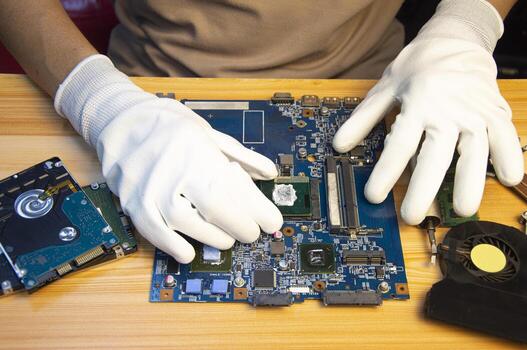
To determine whether a laptop motherboard can be repaired or if it is necessary to replace it, technicians go through a very rigorous and organized procedure. Each major hardware part connects through one of the motherboard’s complex components, thus, accurate diagnosis is an inevitable step before making any decision. The evaluation usually initiates by the identification of the symptoms as mentioned by the user, the laptop not turning on, getting too hot, having screen problems, or not accepting charge. TThese signs point to the presumed location of the affected area on the motherboard.
Visual inspection of the motherboard is the first step of the diagnosis process. The specialists check the motherboard for any geometric damage signs such as burnt parts, discolored areas, torn connectors, rust, or solder joints that have encroached on each other. Liquid damage is Detective by the presence of residues or oxidation appearing on chips and connectors. Experts also check for physical cracks or warping of the board, as these usually signify serious damage that may limit the repair options. Clearly, if the damage is structural or has advanced across multiple layers, then repair is no longer an option.
Once the visual inspection has been done, the technicians carry out electrical testing with the help of specialized instruments. A multimeter and power testers are listed among the tools for voltage detection with the added capability of measuring the electrical features (continuity and resistance) through different circuits. This method helps to detect shorted circuits, open lines, or defective power rails. In case any abnormal readings are detected but restricted only to a certain area of the motherboard, it indicates that the problem can be solved by replacing the faulty part rather than changing the entire board.
Diagnosis at a component level is crucial in identifying whether the part is repairable or not. The technicians involved find out if the power ICs, capacitors, MOSFETs, coils, and BIOS chips are still working by testing them. In case defects occur in one or more of the mentioned components that are also replaceable, the overall assumption is that the motherboard can be repaired. On the contrary, if the case of damage is about the CPU or chipset being glued to the board and thus making repair hard and sometimes even impracticable, then the repair will be less complex.
Moreover, the technicians look at the motherboard’s overheating effects. Thermal stress is usually indicated by heats, marks, or shutdowns. In most cases, the heat-related problems are caused by the solder joints becoming weaker or the chips failing, repairable by re-soldering or chip replacement. The technician then has to make the call whether the area in question can be restored to the point where it will be reliable for the long term without taking risks.
Also, the evaluation factors in BIOS and firmware checks as a very important factor. A BIOS that has been corrupted may prevent the detection of a serious hardware issue, even if the motherboard is in perfect physical condition. Technicians do reflashing or reprogramming of the BIOS chip to test if the system can be brought back to life. If the laptop responds well after the BIOS repair, that indicates the motherboard does not need to be replaced.
Repair cost is one of the main considerations in the decision-making process. Technicians have to calculate the repair cost and consider whether it is still affordable in relation to the laptop’s worth. Old and low-end models may not be worth fixing, but new and high-end laptops often lead to the repair option being justified.
Ultimately, the competency of the technicians combined with the right tools will influence the repairability verdict. Hot-air rework stations and microscopes, for example, along with circuit schematics, will allow for a long-winded but very exact repair. When it comes to the repair of a laptop motherboard, technicians carry out a combination of thorough symptom analysis, visual and electrical testing, component evaluation, and cost consideration. This systematic approach guarantees that the decision is both technically viable and economically wise.
What factors can make a laptop motherboard impossible to repair?
Faced with such scenarios, can make a laptop motherboard impossible to repair might end up diagnosed as irreparable or impractical to repair regardless of the skill of the technicians and the availability of high-level tools. Though many motherboard problems can be sorted out by replacing their components one after another, there are certain situations in which the damage is so bad that only the replacement of the entire board is the most trustworthy option. By knowing these factors, users can be better prepared and have more realistic expectations in times of critical laptop hardware failure.
Repairing a motherboard may be nearly impossible because of its extreme physical damage. Cracks, deep bends, or fractures on the layers of the board cause the disruption of internal circuits which cannot be restored exactly. Given that contemporary motherboards are multi-layered with microscopic pathways, the structural damage tends to affect the hidden connections, thus making repairs unreliable or impossible.
Extensive liquid damage and corrosion can also make a motherboard beyond repair. When liquid exposure is not addressed quickly, corrosion spreads across multiple components and internal layers of the board. If key circuits are eaten away or if rust affects critical chips and connectors, cleaning and component replacement may not restore stable functionality.
Failure of permanently soldered critical components is another major limitation. The CPU, GPU, or chipset is directly soldered to the motherboard in the case of most contemporary laptops. A complex procedure to replace the affected component or even all three, if one of them fails due to overheating or electric damage, is often very expensive, and also not very reliable, especially if no compatible replacement chips are available.
Burnt or shorted motherboard internal layers can mean no repair possible at all. A high voltage surge or a faulty power adapter can lead to internal short circuits that cause damage to several layers of the board. Since accessing and rebuilding these inner layers is not possible with precision, such damage generally ends with the motherboard being permanently inoperative.
Inaccessible or obsolete replacement parts can likewise be the repair’s undoing. A number of motherboard components are proprietary and thus only made by the original manufacturers. If the exact ICs or chips needed for the repair are already out of production or cannot be obtained, the technicians will not be able to carry out the repair even if the damage itself is localized.
Failed repairs can be a significant factor limiting future restoration possibilities. Previous reckless repairs, excessive heating, or poor soldering can lead to damage to solder pads and circuit traces. Once these pads are lifted or damaged, reattaching components becomes very difficult and unreliable.
Extreme overheating damage can make the motherboard weak forever. Long-term exposure to high temperatures can lead to the melting of solder joints, twisting of the board, and simultaneous damage to several components. When heat damage is extensive, fixing one part may not eliminate the problems, and thus the risk of instability over time becomes quite high.
Another major consideration is the economic impracticality of the whole endeavor. Though a motherboard may be repaired from a technical standpoint, the combined costs of labor, rare parts, and testing may dwarf the worth of the laptop. Scenarios like that would lead a technician to suggest the replacement or the upgrade of the device rather than the risky and uncertain repair.
All in all, a laptop motherboard might be deemed beyond repair due to various reasons such as physical damage, extensive corrosion, failure of soldered components, internal layer damage, or unavailability of replacement parts. Overheating, earlier bad repairs, and extremely high repair costs contribute to lower feasibility. Awareness of these factors will aid users in making a right choice when confronted with serious motherboard issues.